
Artificial Skin & Innovation at FlexMedical Solutions
Artificial Skin: How Groundbreaking Research Inspires Innovative Solutions
The biochemistry landscape moves fast, and at FlexMedical Solutions we make a point of keeping pace with new developments that could shape the future of wearable diagnostics. One area that recently caught our eye was a fascinating advance from researchers at Aalto University and the University of Bayreuth, who created a self-healing hydrogel with properties similar to human skin.
Traditionally, hydrogels have offered either high stiffness or self-healing capability — achieving both at once has been a challenge. This new material successfully combines the two, overcoming long-standing limitations and opening the door to exciting applications including drug delivery, wound healing, soft robotics, next-generation sensors and artificial skin systems.
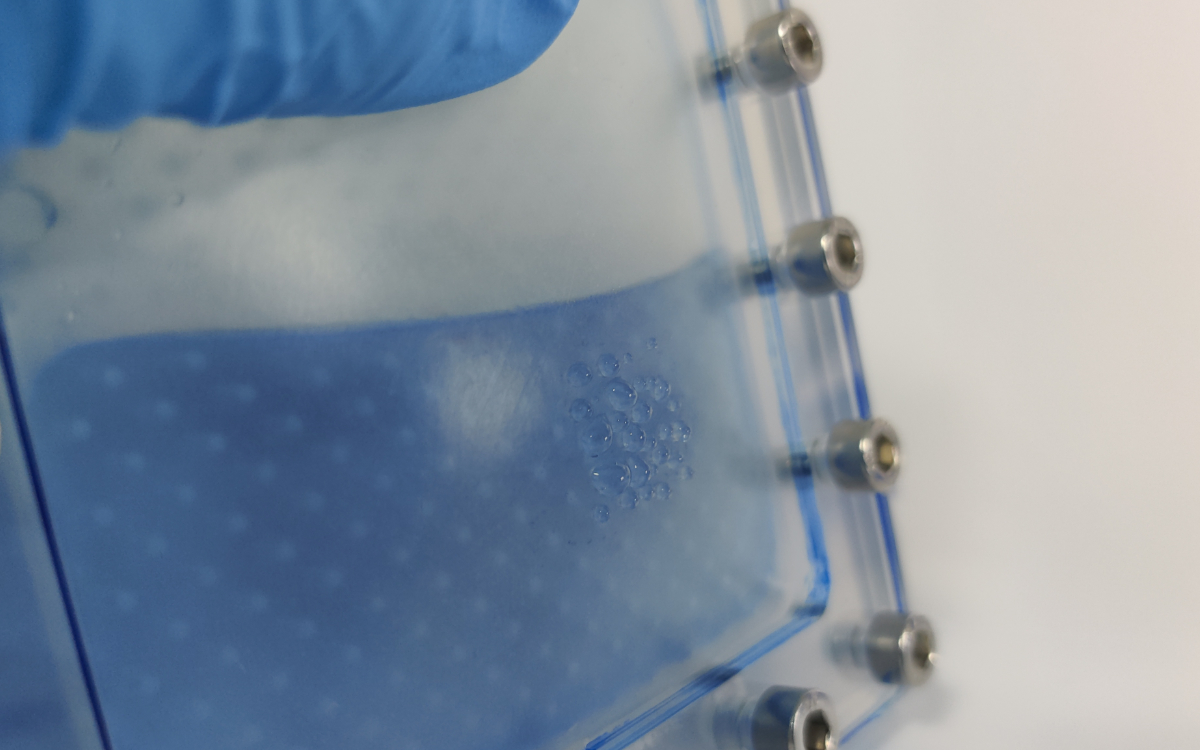
To achieve this, we designed and built a custom test jig capable of replicating a sweat-like effect underneath the wearable patch. This allows rapid, controlled testing of different fluidic designs.
The jig uses a perforated silicone sheet, created using a fine-gauge needle to mimic sweat pores. Once assembled with a dispersion plate and an inlet on the reverse side, the silicone can be gently pressurised with fluid. As pressure builds, droplets emerge through the perforations — much like perspiration through human skin. By connecting the jig to a programmable syringe pump, we can finely tune the flow rate to replicate the sweat levels expected during exercise.
This innovative setup enables us to iterate quickly, gather meaningful data and push our wearable lactate biosensor towards robust, real-world performance. It’s another example of how cross-disciplinary research continues to inspire practical solutions in medical device development.